 The Business Divorce Law Report


Key Takeaways:
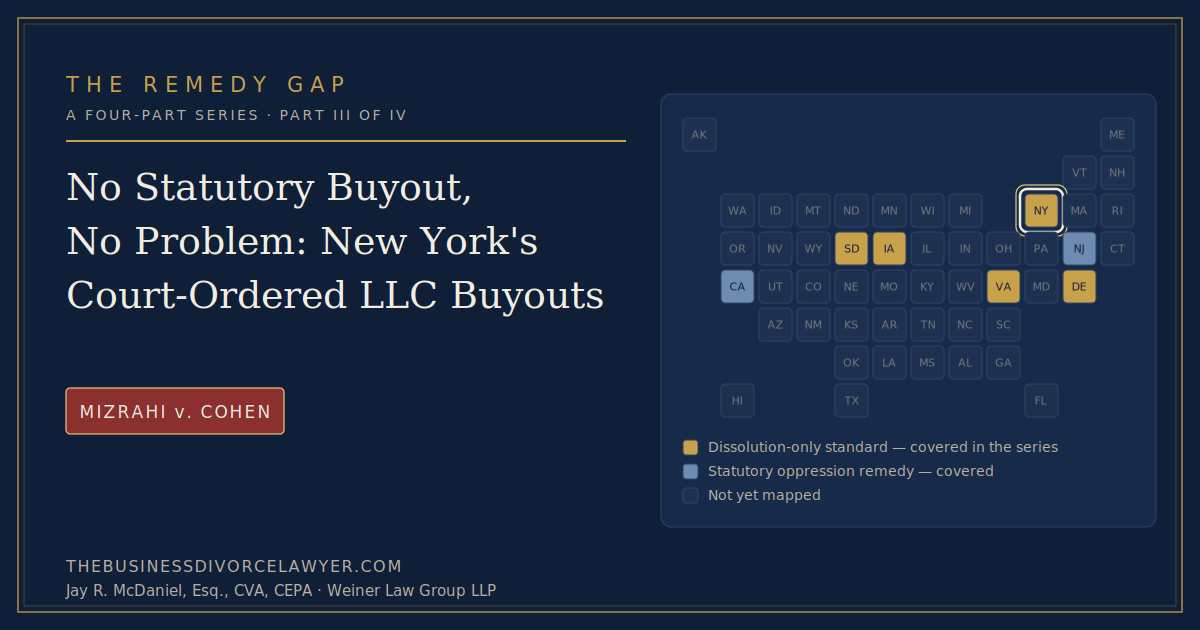
- New York courts order forced buyouts in LLC dissolution cases even though the LLC Law nowhere authorizes them — but only as relief layered onto a winning dissolution claim, never as a workaround for a losing one.
- The doctrine’s turning point is Mizrahi v. Cohen, where the Second Department imposed a buyout the operating agreement did not provide for — converting the equitable buyout from a remedy courts may order into one they sometimes must order.
- No statutory standard of value governs these buyouts. The three leading cases used three different valuation approaches, which means the standard of value, the valuation date, and the discount question are all litigated — not assumed.
- That open valuation terrain is where these cases are won and lost, and it is why the valuation expert belongs on the team before the remedy is argued, not after it is granted.
The New York LLC Law does not authorize a buyout in a dissolution proceeding. The courts have said so repeatedly — and then ordered buyouts anyway. Over roughly a decade of decisions, an LLC equitable buyout doctrine in New York dissolution cases has hardened from a one-off improvisation into relief that, on the right facts, the Appellate Division has held a trial court was required to grant. Sequencing is everything: the buyout is a method of winding up a company a court has already agreed to dissolve. And because the statute that created the remedy does not exist, neither does any statutory answer to the question that decides what the parties actually walk away with — what the interest is worth.

I am a lawyer, a certified valuation analyst, and a certified exit and succession planner. I have worked with closely held business owners throughout my career. Contact me with questions about managing your closely held business and protecting your rights as an owner.
Table of Contents
- The Doctrinal Sequencing
- Key Cases: The Lineage
- Valuation Treatment: The Open Questions That Decide These Cases
- FAQs
- Related Resources
1. The Doctrinal Sequencing
Start with what this doctrine is not. It is not a substitute for the strict dissolution standard of LLC Law § 702, and it is not an exit route for a member whose dissolution claim would fail. The Second Department made the threshold explicit: there is no basis to invoke the equitable buyout remedy unless the petitioner states a viable cause of action for judicial dissolution under § 702. Kassab v. Kasab, 137 A.D.3d 1138 (2d Dept. 2016). The member who cannot satisfy the two-prong 1545 Ocean standard — failed purpose or financial infeasibility — never reaches the buyout question. That fight is covered in the New York playbook: No Oppression Statute, No Forced Exit: The New York LLC Member’s Playbook. For the member who can, the doctrine answers the question the statute leaves open: once dissolution is decreed, how does the company get wound up? The default is liquidation — sell the assets, pay the debts, distribute what remains. The equitable buyout doctrine holds that a court supervising the winding up has discretion, grounded in equity rather than in the LLC Law, to order a different method: one member purchases the other’s interest, preserving the business as a going concern. The doctrine’s development is a study in how far that discretion reaches — and in Mizrahi, whether it remains discretion at all.2. Key Cases: The Lineage
Current through July 2026. Reviewed quarterly. Lyons v. Salamone, 32 A.D.3d 757 (1st Dept. 2006). The doctrine’s origin. Two members of a failing gym business — one holding 80%, the other 20% — reached the end of the road; dissolution was granted. Rather than order a public liquidation, the First Department approved a closed auction as an equitable method of liquidation: each member could bid the fair market value of the other’s interest, with the receiver directed to accept the highest legitimate bid. The court upheld the mechanism over the objection that no buyout remedy exists in the LLC Law. Matter of Superior Vending, LLC, 71 A.D.3d 1153 (2d Dept. 2010). The Second Department joins. In a two-member vending company with no operating agreement, where the non-controlling member had long since ceased participating, the court affirmed — as the most equitable method of liquidation — an order giving the controlling member 45 days to purchase the other’s entire interest for the principal sum of his investment, $256,549.43, plus 9% interest running from the date his participation ended. The decision acknowledged that the LLC Law does not expressly authorize a buyout in a dissolution proceeding, and ordered one anyway, citing Lyons. Mizrahi v. Cohen, 2012 NY Slip Op 50030(U) (Sup. Ct. Kings Co. Jan. 12, 2012). The trial-court foundation — and a decision easy to mischaracterize. This was not a reaffirmation of the strict standard on member-discord facts; it was a grant of dissolution on the financial-infeasibility prong. A 50/50 real estate LLC owning a mixed-use Brooklyn building had operated at a loss from inception. The plaintiff covered roughly $1.2 million in deficits against the defendant’s approximately $300,000; the defendant, meanwhile, withdrew $230,000 from the LLC without consent and did not repay it. Justice Demarest granted dissolution but initially declined to order a buyout, reasoning that the duly executed operating agreement did not authorize one. The plaintiff’s individually pleaded fiduciary damages claim was dismissed on direct-versus-derivative standing grounds — a ruling the Appellate Division later affirmed, citing Abrams v. Donati, 66 N.Y.2d 951, and Tzolis v. Wolff, 10 N.Y.3d 100 — even as the misconduct itself shaped the equities. Mizrahi v. Cohen, 2013 NY Slip Op 50092(U) (Sup. Ct. Kings Co. Jan. 15, 2013). With appraisal evidence showing a public auction of the $4.5 million building would barely clear the mortgage and wipe out both members’ equity, the trial court changed course and ordered a Lyons-style mutual buyout auction — expressly invoking the court’s discretion to exercise principles of equity in fashioning a winding-up mechanism the operating agreement did not supply. Mizrahi v. Cohen, 104 A.D.3d 917 (2d Dept. 2013). The doctrinal turn. The Second Department affirmed dissolution on financial infeasibility — and reversed the denial of the buyout, holding that the trial court should have granted the plaintiff’s application to purchase the defendant’s interest, with the purchase to follow a judicial determination of the interest’s value. The operating agreement’s dissolution provisions did not authorize a buyout; the court held they did not preclude one either, and on these facts — chronic losses funded by one member, unauthorized withdrawals by the other — a unilateral buyout in the funding member’s favor was the appropriate remedy. Not even the trial court’s mutual auction was enough. The equitable buyout went, in one paragraph, from a remedy courts may order to one that, in the right posture, they must. Cortes v. 3A N. Park Ave Rest Corp., 46 Misc. 3d 670 (Sup. Ct. Kings Co. 2014). The doctrine migrates. In a common-law dissolution proceeding involving a closely held corporation — not an LLC — the same court cited Mizrahi as authority for a buyout remedy, while grounding the valuation mechanics primarily in BCL § 1118. The citation matters less for its holding than for its direction of travel: judge-made buyout relief, born in the LLC context, being borrowed back into corporate dissolution.3. Valuation Treatment: The Open Questions That Decide These Cases
Here is the part of Mizrahi that matters most in practice and gets discussed least. The Appellate Division did not fix a price, adopt a standard of value, or prescribe a methodology. It remitted for a determination of the value of the defendant’s interest, with the plaintiff permitted to purchase within sixty days of that determination. Every substantive valuation question was left open — because no statute answers them. Contrast the corporate side. A BCL § 1118 election triggers a fair-value appraisal with a statutory valuation date, a developed body of case law on discounts, and decades of appellate guidance. The LLC equitable buyout has none of that architecture, and the three leading cases resolved the value question three different ways: In Lyons, the market set the price and the auction set the date. Each member bid fair market value for the other’s interest; value was determined by, and as of, the auction itself. No appraisal, no standard-of-value fight — but also no protection for the member with shallower pockets, since a closed auction rewards liquidity as much as valuation. In Superior Vending, the court priced the exit off the investment. The bought-out member received his capital contribution plus a 9% return, with interest running from — and interim distributions excluded after — the date his participation in the business ended. Functionally, the court selected a valuation date years before the decision and measured value by contribution rather than by the enterprise’s worth. A member whose company appreciated substantially would fare far worse under this approach than under a going-concern appraisal. In Mizrahi, the court ordered a judicial valuation and said nothing about how to conduct it. Standard of value, valuation date, entity-level versus interest-level value, minority and marketability discounts, the treatment of the defendant’s unrepaid $230,000 withdrawal and the plaintiff’s $1.2 million in advances — all of it left to the remand. On discounts alone the stakes are substantial: whether a 50% interest in a real estate LLC is valued as half the appraised realty net of debt, or as a discounted non-controlling interest, can move the price by a third. Misconduct adds a further layer. In Cortes, the court observed that a member’s wrongdoing or misappropriation of company assets is relevant to the valuation determination where it has adversely affected the company’s value — a principle articulated in the BCL context but squarely presented whenever, as in Mizrahi, the bought-out member’s defalcations helped create the infeasibility that justified dissolution in the first place. The strategic consequence is direct: in a New York LLC buyout, the valuation contest is not an appraisal proceeding applied to a settled framework — it is the framework fight itself. The party who arrives with a coherent theory of the standard of value, the date, the discount treatment, and the misconduct adjustments frames the remand. The party who treats valuation as a post-judgment detail inherits the other side’s framing.4. FAQs
Can a New York court force an LLC member to sell their interest?
Yes, but only as an equitable remedy upon judicial dissolution. The LLC Law does not authorize buyouts, yet in Lyons, Superior Vending, and Mizrahi the Appellate Division approved or ordered them as equitable methods of winding up a dissolved LLC. Without a viable § 702 dissolution claim, there is no path to a forced buyout.Does the operating agreement have to authorize a buyout?
No. In Mizrahi, the operating agreement’s dissolution provisions did not provide for a buyout, and the Second Department held they did not preclude one — then ordered a buyout the trial court had refused. Silence in the agreement leaves the remedy to the court’s equitable discretion.How is the price of the bought-out interest determined?
There is no statutory answer. The leading cases used three different approaches — a closed auction at fair market value, repayment of capital plus a fixed return, and a judicial valuation on remand — and no appellate decision has fixed a standard of value, valuation date, or discount rule for LLC buyouts. Each of those questions is litigated case by case, which makes credentialed valuation analysis central to the outcome rather than incidental to it.Who gets to be the buyer?
It depends on the equities. Lyons gave both members the chance to bid; Mizrahi awarded a unilateral purchase right to the member who had funded the company’s losses, over the member who had made unauthorized withdrawals. Disproportionate contribution and financial misconduct by the other member are the recurring facts behind one-sided purchase rights.5. Related Resources
- Dissolution or Oppression? Mapping the Minority Member’s Remedy Gap by State
- No Oppression Statute, No Forced Exit: The New York LLC Member’s Playbook
- When to Seek Judicial Dissolution of an LLC
If you are litigating an LLC dissolution or buyout and the valuation questions are open — standard of value, valuation date, discounts, misconduct adjustments — I work with litigation counsel as valuation counsel and a Certified Valuation Analyst in member and shareholder disputes, including matters where no statutory valuation framework applies. Contact for co-counsel and valuation engagements.
Jay R. McDaniel, Esq., CVA, CEPA, is Chair of the Corporate & Business Law practice at Weiner Law Group, leader of its Business Divorce Practice, and founder of Closely Held Advisors. Attorney Advertising. This article is for informational purposes only and does not constitute legal advice or create an attorney-client relationship. Prior results do not guarantee a similar outcome.