 The Business Divorce Law Report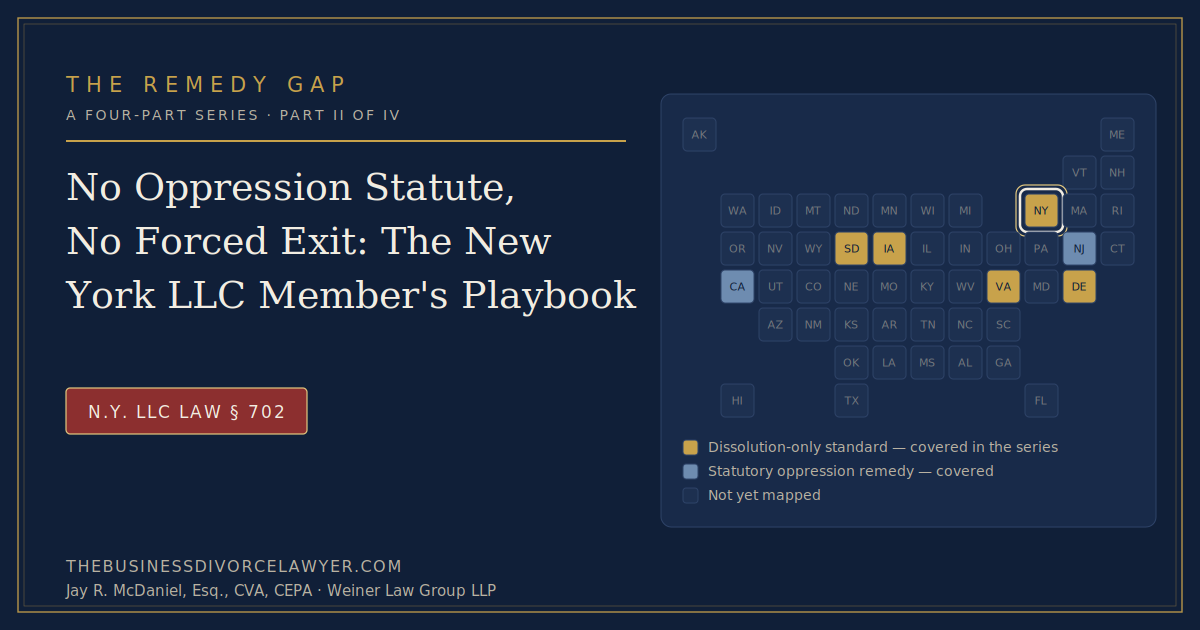
Key Takeaways:
- New York gives an oppressed LLC member no oppression statute. LLC Law § 702 is the sole route to judicial dissolution, and the courts apply it more strictly than the corporate oppression standard — exclusion from management, unpaid distributions, and member discord do not, by themselves, state a claim.
- The two grounds that survive are failed purpose and financial infeasibility, both measured against the operating agreement. Facts that fit those prongs win; freeze-out facts dressed up as dissolution claims get dismissed at the pleading stage.
- The realistic leverage for a frozen-out member lies elsewhere: fiduciary duty and accounting claims, books-and-records demands, and derivative claims — theories that produce damages and pressure rather than exit.
- The absence of a forced-exit mechanism is a valuation problem. No dissolution win means no triggered valuation date and no buyout leverage until a separate claim creates one.
A minority member of a New York LLC who is cut off from management and distributions is searching, in effect, for LLC member oppression remedies New York law never enacted. The Business Corporation Law gives oppressed shareholders a dissolution claim and a fair-value buyout; the LLC Law gives members neither. What it gives instead is a single dissolution standard that courts construe strictly — and a set of alternative theories that supply real leverage when the standard cannot be met. This is the playbook: what dissolution actually requires, why it usually fails on freeze-out facts, and where the pressure points actually are.

I am a lawyer, a certified valuation analyst, and a certified exit and succession planner. I have worked with closely held business owners throughout my career. Contact me with questions about managing your closely held business and protecting your rights as an owner.
Table of Contents
1. The Doctrinal Standard
LLC Law § 702 permits judicial dissolution “whenever it is not reasonably practicable to carry on the business in conformity with the articles of organization or operating agreement.” That sentence is the entire statutory universe. There is no oppression ground, no deadlock ground, no unfairness ground. New York sits squarely in the contractarian family of LLC statutes, as covered in the multi-state framework this piece belongs to: Dissolution or Oppression? Mapping the Minority Member’s Remedy Gap by State. The Second Department fixed the standard’s meaning in Matter of 1545 Ocean Avenue, LLC: the petitioner must show either that management is unable or unwilling to reasonably permit or promote the LLC’s stated purpose, or that continuing the entity is financially unfeasible. Both prongs are measured against the operating agreement, not against fairness. The court expressly rejected a divorce-style equitable standard, and it rejected importing dissolution grounds from the Business Corporation Law or the Partnership Law. Two consequences follow. First, the operating agreement is the battlefield. A broad purpose clause makes failed purpose nearly impossible to prove; a specific one gives the petitioner something to measure failure against. Second, misconduct is not the test. A controlling member can behave badly — even in ways that would constitute textbook oppression under BCL § 1104-a — and the LLC still “carries on its business in conformity with” its agreement. Under § 702, the entity’s viability is the question. The member’s mistreatment is not. Kassab v. Kasab closed the door New York practitioners kept testing. The petitioner there alleged exclusion from management — a classic oppression fact. The court held the allegations insufficient, described the LLC standard as more stringent than the corporate one, and declined to read BCL oppression doctrine into the LLC Law. And at the trial level, Matter of Horning v. Horning Construction, LLC supplies the cautionary baseline: a founder locked in mutual loathing with his co-members, no operating agreement at all, and still no dissolution — the court held it had no discretion to dissolve absent the statutory showing, however untenable the working relationship. Mistrust, resentment, and a failed buyout negotiation are not a § 702 case.2. Key Cases
Current through July 2026. Reviewed quarterly. Matter of 1545 Ocean Avenue, LLC, 72 A.D.3d 121 (2d Dept. 2010). The controlling standard: failed purpose or financial infeasibility, measured against the operating agreement. Manager conflict over a real estate project nearing completion did not qualify; the LLC’s purpose was being achieved despite the discord. Matter of Kassab v. Kasab, 195 A.D.3d 830 (2d Dept. 2021). Exclusion from management, standing alone, does not satisfy § 702. The LLC standard is more stringent than BCL § 1104-a, and the court will not import corporate oppression doctrine into the LLC Law. Dismissal at the pleading stage affirmed. Matter of Horning v. Horning Construction, LLC, 12 Misc. 3d 402 (Sup. Ct. Monroe Co. 2006). Three equal members, no operating agreement, a relationship the petitioner described as poisoned beyond repair — and no dissolution. The court has no discretion to dissolve absent the statutory showing, and a member cannot manufacture exit by declaring the relationship unbearable. Mizrahi v. Cohen, 104 A.D.3d 917 (2d Dept. 2013). The other side of the ledger: dissolution granted on financial infeasibility where a 50/50 real estate LLC operated at a loss from inception and one member unilaterally funded the deficits — followed by a court-ordered buyout the operating agreement never provided for. The buyout doctrine is developed in a companion piece: No Statutory Buyout, No Problem: How New York Courts Order Forced Buyouts in LLC Dissolution Cases.3. The Realistic Playbook
Plead dissolution only when the facts genuinely fit the prongs. A § 702 count built on freeze-out allegations is not a throwaway — it is a liability. Kassab-style dismissals come early, they hand the controlling member a win at the courthouse door, and they weaken the credibility of the claims that remain. The dissolution count belongs in the complaint when the purpose clause is specific and defeated, or when the numbers show the entity cannot support itself — the Mizrahi pattern of chronic losses funded unilaterally by one member. Let fiduciary duty and accounting claims carry the merits. New York imposes common-law fiduciary duties on managing members, and unlike dissolution, a fiduciary claim targets the conduct: diverted funds, self-dealing transactions, compensation the majority pays itself in lieu of distributions. These claims produce damages, disgorgement, and an accounting — and each finding of misconduct builds settlement pressure that a doomed dissolution count never generates. Claims for injury to the LLC itself must be brought derivatively, a distinction with teeth: in Mizrahi, the plaintiff’s individually-pleaded fiduciary claim was dismissed on exactly that ground even as his dissolution claim succeeded. Use the books-and-records lever early. An inspection demand is cheap, fast, and forces the controlling member to open the finances that freeze-outs depend on concealing. What it produces feeds everything else: the accounting claim, the derivative complaint, and the valuation model. Understand what the endgame is. There is no forced buyout waiting at the end of a New York LLC dispute unless a dissolution claim succeeds first — the courts have made the sequencing explicit, holding that there is no basis to invoke the equitable buyout remedy unless the petitioner states a viable § 702 claim. Kassab v. Kasab, 137 A.D.3d 1138 (2d Dept. 2016). The realistic endgame in most matters is a negotiated exit priced off the leverage the litigation creates. The litigation is the valuation event’s substitute — which is precisely why the economics need to be modeled before the complaint is drafted.4. Valuation Treatment
The absence of a forced-exit mechanism creates a valuation-timing problem that is easy to miss until it controls the case. In a BCL § 1104-a proceeding, the filing itself can trigger a § 1118 fair-value election, which fixes a statutory valuation date and converts the dispute into an appraisal contest. A New York LLC member gets none of that machinery. No dissolution win means no triggered valuation date, no appraisal proceeding, and no buyout leverage until a separate cause of action — a fiduciary judgment with an accounting, a successful dissolution claim, a negotiated deal — creates one. The practical consequences run in the controlling member’s favor. Time costs the majority nothing; every year of suspended distributions transfers value from the minority’s interest to the majority’s salary line. And because no statutory standard of value attaches to any eventual exit, even the measure of what the interest is worth — fair value, fair market value, discounted or undiscounted — is itself up for negotiation or litigation. The member who arrives at the settlement table with a credible valuation model, a documented damages theory, and a fiduciary record built through discovery negotiates from a fundamentally different position than one holding only grievances. In these engagements the valuation work is not an afterthought to the legal claims; it is the leverage.5. FAQs
Can I force dissolution of a New York LLC if I’ve been frozen out?
Rarely on freeze-out facts alone. Under 1545 Ocean Avenue and Kassab, exclusion from management and member discord do not satisfy LLC Law § 702. You must show the LLC’s stated purpose has failed or that continuing the entity is financially unfeasible, both measured against the operating agreement.Does New York have an oppression statute for LLC members?
No. BCL § 1104-a protects oppressed shareholders of closely held corporations, but New York courts have expressly refused to import that standard into the LLC Law. Section 702’s “not reasonably practicable” test is the sole dissolution ground, and it is more stringent than the corporate standard.What claims actually give a minority LLC member leverage in New York?
Breach of fiduciary duty, an accounting, derivative claims for injury to the company, and books-and-records demands. These target the controlling member’s conduct, produce damages and disclosure, and build the record and the pressure that drive negotiated buyouts.What does this mean for the value of my membership interest if I can’t get dissolution?
Without a dissolution decree there is no triggered valuation date and no forced liquidity event, so the interest can be starved of distributions indefinitely while retaining only paper value. Value gets realized through a fiduciary judgment, a negotiated exit, or a successful dissolution claim — and because no statutory standard of value applies to New York LLC exits, the measure of value itself must be established through expert valuation work rather than assumed.Is it easier to dissolve an LLC that has no operating agreement?
No. In Horning, the LLC had no operating agreement at all and dissolution was still denied; the statute’s default provisions filled the gap and the court held it lacked discretion to dissolve absent the statutory showing. The absence of an agreement removes exit mechanisms without lowering the dissolution bar — the worst of both positions.6. Related Resources
- Dissolution or Oppression? Mapping the Minority Member’s Remedy Gap by State
- No Statutory Buyout, No Problem: How New York Courts Order Forced Buyouts in LLC Dissolution Cases
- When to Seek Judicial Dissolution of an LLC
If you are a minority member of a New York LLC being frozen out of management or distributions, the claims available to you — and the value you can realize — depend on decisions made before anything is filed: which counts to plead, which to withhold, and how to build the valuation record that drives the exit. Schedule a consultation.
Jay R. McDaniel, Esq., CVA, CEPA, is a Partner in the Corporate & Business Law practice at Scarinci Hollenbeck, LLC, and founder of Closely Held Advisors, leader of its Business Divorce Practice, and founder of Closely Held Advisors. Attorney Advertising. This article is for informational purposes only and does not constitute legal advice or create an attorney-client relationship. Prior results do not guarantee a similar outcome.