Articles Posted in Minority Oppression

Delaware highlighted, fiduciary duty waiver under 6 Del. C. § 18-1101(c)


Key Takeaways:

  • Delaware lets LLC members contract away fiduciary duties almost entirely — 6 Del. C. § 18-1101(c) permits an LLC agreement to expand, restrict, or eliminate them — which makes the waiver provision the single most consequential clause in a Delaware operating agreement.
  • The waiver power has a floor that cannot be drafted away: § 18-1101(e) preserves liability for bad-faith violation of the implied covenant of good faith and fair dealing.

New York highlighted, LLC Law § 702


Key Takeaways:

  • New York courts order forced buyouts in LLC dissolution cases even though the LLC Law nowhere authorizes them — but only as relief layered onto a winning dissolution claim, never as a workaround for a losing one.
  • The doctrine’s turning point is Mizrahi v. Cohen, where the Second Department imposed a buyout the operating agreement did not provide for — converting the equitable buyout from a remedy courts may order into one they sometimes must order.

New York highlighted, Mizrahi v. Cohen equitable buyout


Key Takeaways:

  • New York gives an oppressed LLC member no oppression statute. LLC Law § 702 is the sole route to judicial dissolution, and the courts apply it more strictly than the corporate oppression standard — exclusion from management, unpaid distributions, and member discord do not, by themselves, state a claim.
  • The two grounds that survive are failed purpose and financial infeasibility, both measured against the operating agreement. Facts that fit those prongs win; freeze-out facts dressed up as dissolution claims get dismissed at the pleading stage.

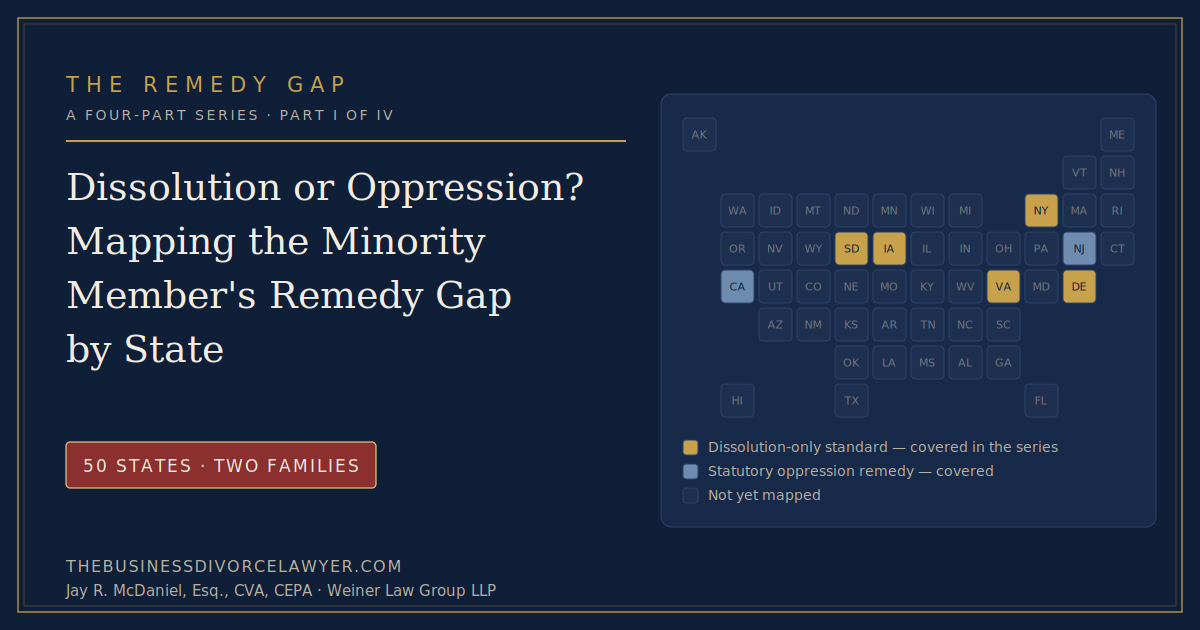
Tile map of U.S. states comparing LLC minority oppression remedies by state: dissolution-only jurisdictions versus statutory oppression remedies


Key Takeaways:

  • Not every state gives an oppressed LLC member a statutory remedy. New York and Delaware confine judicial dissolution to the strict “not reasonably practicable” standard; New Jersey’s LLC statute expressly authorizes relief for oppression, and that power cannot be waived in the operating agreement.
  • In the gap states, freeze-out conduct alone rarely wins dissolution. The realistic paths are fiduciary duty claims — which produce damages, not exit — and, in New York, a court-fashioned buyout available only after a dissolution claim succeeds.

NJ Minority Shareholder & LLC Oppression — Guide

New Jersey law gives minority shareholders in close corporations and LLC members powerful remedies when those in control act oppressively—from injunctions to court‑ordered buyouts at fair value. This guide explains what counts as “oppression,” how courts analyze remedies and valuation, and how to prepare your case.


anger-2728273_1920-1024x683

What “oppression” means in New Jersey (in plain English)

Key Takeaways:

  • Minority shareholders in closely held corporations may face a challenge to their investment due to their lack of control over company decisions.

  • Legal protections do exist to safeguard their interests, including rights to financial information, fair treatment, and avenues for relief in cases of oppression.

  • State laws vary, with New Jersey, New York, and Delaware each offering different levels of protection and remedies for minority shareholders.


In closely held corporations, minority shareholders—those holding less than 50% of the company’s shares—often find themselves at the mercy of the decisions of majority shareholders.

This imbalance can lead to situations where the minority’s interests are overlooked or actively undermined. To address these challenges, various legal protections have been established, though they differ significantly across jurisdictions.

Judicial Dissolution | Judicial Dissociation | Attorneys | LawyersUnderstanding Minority Shareholder Oppression

Minority shareholder oppression occurs when majority shareholders engage in actions that are harmful, unfair, or abusive toward minority shareholders. Such actions can include:

  • Withholding dividends
  • Denying access to essential financial information
  • Excluding minority shareholders from key decision-making processes
  • Implementing “squeeze-out” tactics to force minority shareholders to sell their shares at undervalued prices

The definition and remedies for shareholder oppression vary by state, making it crucial to understand the specific laws applicable in each jurisdiction.

Legal Protections for Minority Shareholders

Minority shareholders are entitled to certain fundamental rights to protect their interests:

Access to Financial Information

Continue reading

  • Shareholder Disputes in closely held corporations are common and often arise from voting deadlocks, financial disagreements, and claims of minority shareholder oppression.

  • New York law provides several legal remedies, including dissolution proceedings, buyouts, and derivative lawsuits.

  • Preventative measures, such as well-drafted shareholder agreements, can mitigate future disputes.

Key Takeaways: When to Seek Judicial Dissolution of an LLC

  • What is Judicial Dissolution? A court-ordered termination of an LLC when voluntary dissolution is not an option.
  • When Should You Seek It?
    • Deadlock among members preventing essential business decisions.
    • Conflicts that make business operations impossible.
    • Fraud, oppression, or misconduct by controlling members.
    • The LLC can no longer fulfill its intended purpose.
  • Legal Standards for Judicial Dissolution:
    • Strict Approach (New York, Delaware): Only granted when the LLC is no longer “reasonably practicable.”
    • Broader Approach (Uniform LLC Act States): Courts may dissolve an LLC for deadlock, oppression, or fraud.
  • How to Proceed? Consult a business litigation attorney to evaluate your legal options and protect your rights.

There are times when disputes among members of a limited liability company can reach the point where continuing the business becomes impossible. When the conflicts are intractable, a lawsuit for judicial dissolution is a way for the owners to find a remedy .

Limited Liability Company Dissolution Lawyer | LLC Dissolution Attorney

The remedies available to LLC members in a judicial dissolution action vary from state to state, and it is critical to owners to have a clear understanding of what is and is not possible Some states, such as New York and Delaware, are narrow in the remedies available, assuming that the members are best able to manage their affairs through contracts between them. This “strict approach” permits judicial dissolution only when it is “not reasonably practicable” to continue operations in compliance with the LLC’s operating agreement.

Other states, particularly those that have enacted the Uniform Limited Liability Company Act (ULLCA), offer a more flexible framework. In these states, members can pursue judicial dissolution on broader grounds, including minority oppression, illegality, and fraudulent behavior.

Continue reading

  • Shareholder disputes in a closely held business threaten the business and personal financial interests of the owner.

  • New Jersey law provides the owners of a closely held corporation with rights and remedies that assure access to information and the financial benefits of ownership.

  • Closely held corporations can use effective planning and negotiated solutions to avoid litigation.


Shareholder disputes are often disruptive, emotional, and, if left unresolved, devastating to the closely held corporations that are the backbone of New Jersey’s economy. When these disagreements arise in a closely held business with only a handful of key stakeholders, they can escalate quickly, placing the company’s operations — and the personal futures of the owners — at risk.

Shareholder Disputes: It Isn’t Just Business, It’s Personal

Shareholder disputes aren’t just about financial disagreements. They often stem from deeply personal frustrations, competing visions, or the inherent complexity of running a business in which power and resources are shared by a few individuals.

New Jersey Shareholder Disputes Attorney | Minority Oppression Attorney New Jersey CorporationWhether the conflict involves voting deadlocks, allegations of unfair treatment, or disagreements over financial management, the stakes are high for all involved.

Understanding the common causes of these disputes—and the legal remedies available—can make the difference between a resolution that preserves the business and a breakdown that leads to its dissolution.

The Common Causes of Shareholder Disputes

Every closely held corporation is unique, but the disputes they face tend to follow familiar patterns. Recognizing these common issues is the first step in addressing them effectively. Continue reading

It’s a decision involving a law firm partnership that, if widely followed, will likely have a sweeping effect on the interpretation of the statutory requirement for unanimity in adopting critical agreements that govern partnerships and liited liability companies.Lerner-David

Attorney Andrew Zidel, an attorney who left prominent intellectual property boutique firm Lerner David in Westfield, failed in his attempt to use a minority veto to block the adoption of a law firm partnership agreement that treated retiring partners differently than withdrawing partners.

The trial court finessed the unanimity requirement found in the partnership statute, and was affirmed in an unreported decision of the appellate division.

Court Discounts Literal Language of Partnership Statute; Implies Consent to Adopt Partnership Agreement

The reason for Zidel’s failure to rely on the language of the statute was that the law firm had, for many years, operated without a formal partnership agreement. Therefore, the trial court found that the written formal agreement would be considered an amendment to the existing partnership agreement, and, under the partnership’s prior practices, it did not require a unanimous agreement.

Continue reading

Contact Information