Articles Tagged with new jersey

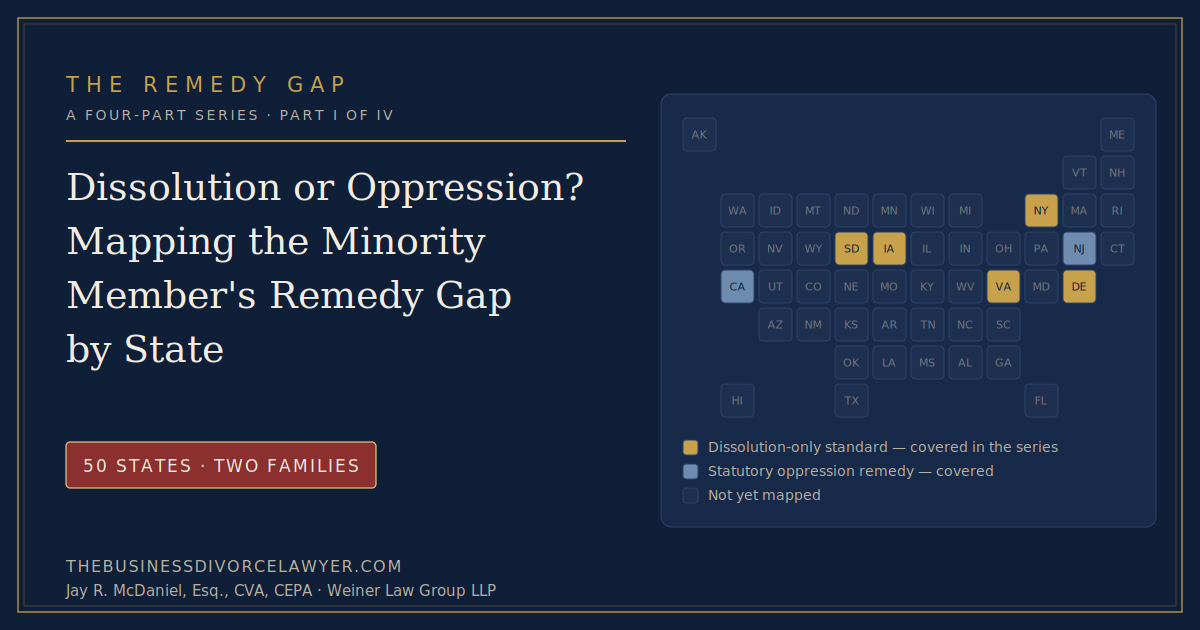
Tile map of U.S. states comparing LLC minority oppression remedies by state: dissolution-only jurisdictions versus statutory oppression remedies


Key Takeaways:

  • Not every state gives an oppressed LLC member a statutory remedy. New York and Delaware confine judicial dissolution to the strict “not reasonably practicable” standard; New Jersey’s LLC statute expressly authorizes relief for oppression, and that power cannot be waived in the operating agreement.
  • In the gap states, freeze-out conduct alone rarely wins dissolution. The realistic paths are fiduciary duty claims — which produce damages, not exit — and, in New York, a court-fashioned buyout available only after a dissolution claim succeeds.


  • The Revised Uniform Limited Liability Company Act adopted in New Jersey permits a court to expel a member of a limited liability company when it is not reasonably practicable for the company to continue with that individual as a member.

  • Expulsion, known as involuntary dissociation, based on the not reasonably practicable standard requires a showing that there is a structural impediment to the members continuing in business together, such as deadlock.

  • When the company is able to make decisions and pursue its business purpose, the not reasonably practicable standard does not exist, whatever the level of animosity among the members.

supreme-court-building-1209701_640

The New Jersey Supreme Court will consider the standards for expulsion of a member from a limited liability company.  The Court granted certification   in  IE Test, LL27518-ie-logo-colorC v. Carroll, Docket NO. A-6159-12T4 (N.J. Super. App. Div., March 17, 2015)(see our discussion here.) The opinion construes N.J.S.A. 42:2B-24(b)(3)(a) of the now repealed Limited Liability Company Act.

The language, however, is nearly identical to that found in New Jersey’s current LLC law, the Revised Uniform Limited Liability Company Act (RULLCA) N.J.S.A. 42:2C-46(e)(3), which governs the involuntary dissociation of members.  Here the court affirmed the expulsion of the defendant based on the impracticability of the business continuing with him as member. the now-repealed Limited Liability Company Act.

Seven-Factor Test Applied to Expulsion

Contact Information